
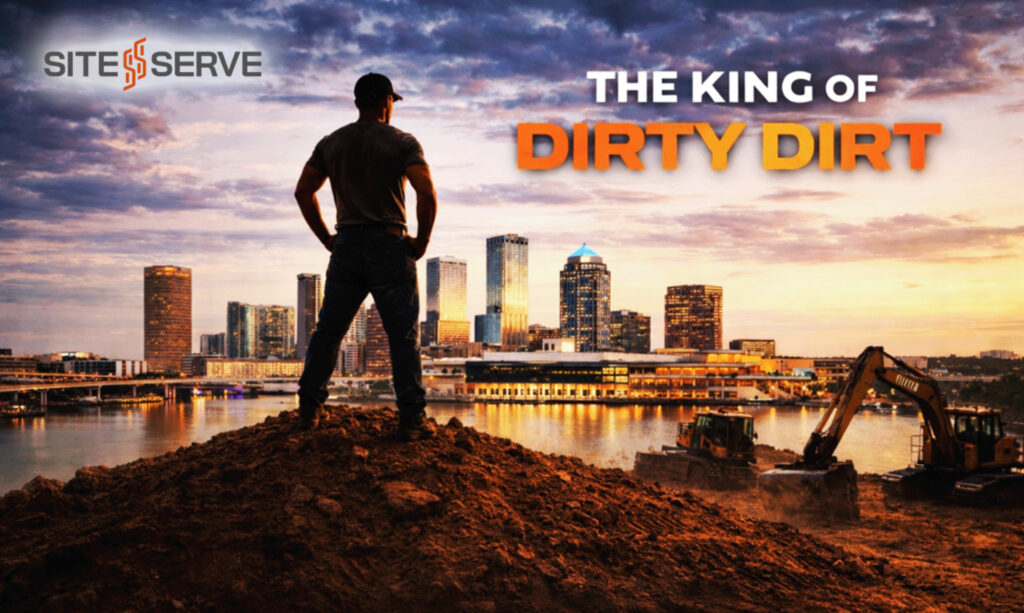
At first glance, it looks like dirt. Just piles of it…moved, shaped, hauled, and packed down across job sites throughout Tampa Bay. But to the team at Site Serve, dirt is where everything begins.
Before the steel rises. Before the concrete is poured. Before a project ever becomes visible, there is a moment when the land must be understood, cleared, reshaped, and made ready. That is where Site Serve lives.
Founded by Tampa native Chris Bodie, the company has grown around a simple idea that has become increasingly rare in construction: do the foundational work right the first time, and everything that follows works better.
But Site Serve was never built around one man. It was built around a mindset. A standard.
One that shows up the same way on every job site, whether it is a small parcel or a major commercial development. A standard that says dirt is not just dirt, it is drainage, compaction, stability. It is whether a project holds up over time or quietly fails beneath the surface.
Inside the industry, there is a phrase that has started to stick.
The King of Dirty Dirt.
It is not about ego. It is about ownership. Ownership of the work most people never see, but that every project depends on.
That ownership lives across the team, operators, project managers, drivers, and field crews. The people who show up early, stay late, and understand that every inch of ground matters.
Bodie set the tone, but it is the team that carries it forward every day.
Together, they handle everything from land clearing and excavation to grading, demolition, and fencing, often stepping into projects at the earliest and most critical stages. They are the ones called when timelines are tight, conditions are unpredictable, and there is no margin for error.
What separates Site Serve isn’t execution. It’s how they think.
Where others see a problem and walk away, this team leans in.
There are projects where standard equipment does not work, where soil conditions, access constraints, or structural challenges make traditional approaches impossible. Jobs that stall. Jobs that get passed from contractor to contractor.
Those are often the calls Site Serve gets. And instead of saying no, they figure it out.
That has meant designing and fabricating custom solutions in the field, including specialized drill bits and modified equipment built specifically for the conditions at hand. It is not theoretical. It is practical problem solving, driven by experience and a refusal to let a project fail because the standard playbook came up short.
It is a mindset that runs through the entire team.
Adapt. Solve. Deliver.
“Every job is different,” said Michelle Walker, Site Serve’s Director of Business Development. “Our role is to understand the conditions, the constraints, and the end goal, and then build the right approach from the ground up.”
At this level, doing the job is not enough. The job has to get done.
Because in a place like Tampa Bay, where rapid growth meets challenging soil conditions and shifting water tables, the difference between success and failure often starts below the surface.
What many outside the industry do not realize is that not all dirt is usable. In fact, much of what is uncovered on job sites across Tampa Bay is what professionals refer to as “dirty dirt.”
Soil contaminated by decades of prior use. Fuel-soaked ground from old tanks and infrastructure. Fill material mixed with debris, concrete, and waste. Sites flagged for environmental concerns or material that simply will not pass inspection for reuse.
In a fast-growing region like Tampa Bay, this is not the exception. It is the norm.
“A lot of people underestimate what’s happening below the surface,” said David Bearce, P.E., S.I., Southwest Florida Regional Vice President at ECS Limited, who brings more than 29 years of site development experience in the region. “You’re dealing with legacy conditions, environmental concerns, and tight redevelopment timelines. It takes a different level of problem-solving to navigate that.”
This is a market built on layers of history, former industrial land, aging infrastructure, rapid redevelopment. Projects like Water Street Tampa have transformed entire sections of the urban core, while developments like Gasworx in Ybor City are reshaping legacy areas into modern mixed-use destinations.
But before any of that transformation can happen, the ground itself must be corrected.
Because if the dirt is wrong, everything built on it is already compromised.
“In Tampa right now, you don’t get second chances on timelines,” said Frank Rygiel, President of CSI Construction of Tampa, a local development partner involved in large-scale mixed-use projects. “If the site work isn’t right, everything backs up. Teams like Site Serve aren’t just helpful, they’re critical to keeping projects moving.”
Timelines slip. Costs rise. Projects stall. That is why “dirty dirt” is not just a condition. It is a critical moment in every development, and why the teams that know how to solve it have become essential to the future of the region.
That is where Site Serve has built its reputation. Not on what people see, but on what they don’t.
The company has become a trusted partner for developers, contractors, and municipalities who understand that getting the ground right is not a line item. It is the foundation of everything.
Bodie does not position himself as the hero of that story. He positions the team.
The people who take raw, unpredictable ground and turn it into something ready to build on. The people who solve problems before they become delays. The people who stand behind their work long after the job is complete.
As Tampa Bay continues to grow, the spotlight will remain on what gets built. But behind every structure, every roadway, every development, there is a team that made it possible before anyone else arrived.
A team that understands the ground beneath it better than most. A team that earned its name not through marketing, but through consistency.
The King of Dirty Dirt.
