
The excavator bucket came up wrong.
The operator knew it before he even looked. The smell hit first. That sharp petroleum bite that hangs in the air on a hot Florida morning. Then the color: dark, oily, streaked with something no natural deposit puts there.
The crew stopped. That bucket never went back in the clean stockpile.
That moment happens on job sites across Tampa Bay every week. Infill lots. Redevelopment parcels. Old industrial tracts that look clean from the street. The surface tells you nothing. The machine tells you the truth.
Knowing what to do next is the difference between a clean project and a liability that follows the material wherever it goes. It is why Chris Bodie has become known as the King of Dirty Dirt.
Site Serve handles contaminated soil across the full range of Tampa Bay development. Large-scale marina districts. Commercial site prep. Institutional builds. Residential infill. No project is too small to require the right process, and no project is too large to cut corners on it.
What Is Dirty Dirt?
Dirty dirt is any excavated or imported soil that cannot legally be reused as clean fill, requires a permitted disposal facility, and generates hauling and manifest costs. The term covers three distinct categories in Florida, each with its own legal requirements, handling procedures, and disposal paths.
Chemically Contaminated Soil
This is the most dangerous type, and the hardest to catch. Petroleum hydrocarbons, heavy metals like lead and arsenic, chlorinated solvents, PCBs. The material can look completely normal. No discoloration. No odor. Contamination at this level is invisible until it is tested.
That is what makes it a problem. A contractor who moves it without knowing what it is has already started the clock on a liability event.
Debris-Mixed Fill
Concrete chunks, asphalt fragments, glass, metal scrap, demolition waste. Soil that has been mixed with material it was never supposed to touch. This type is usually visible once you get into it. But visually clean is not the same as legally clean, and debris-mixed fill cannot go to a clean fill site regardless of how it looks.
Structurally Unsuitable Material
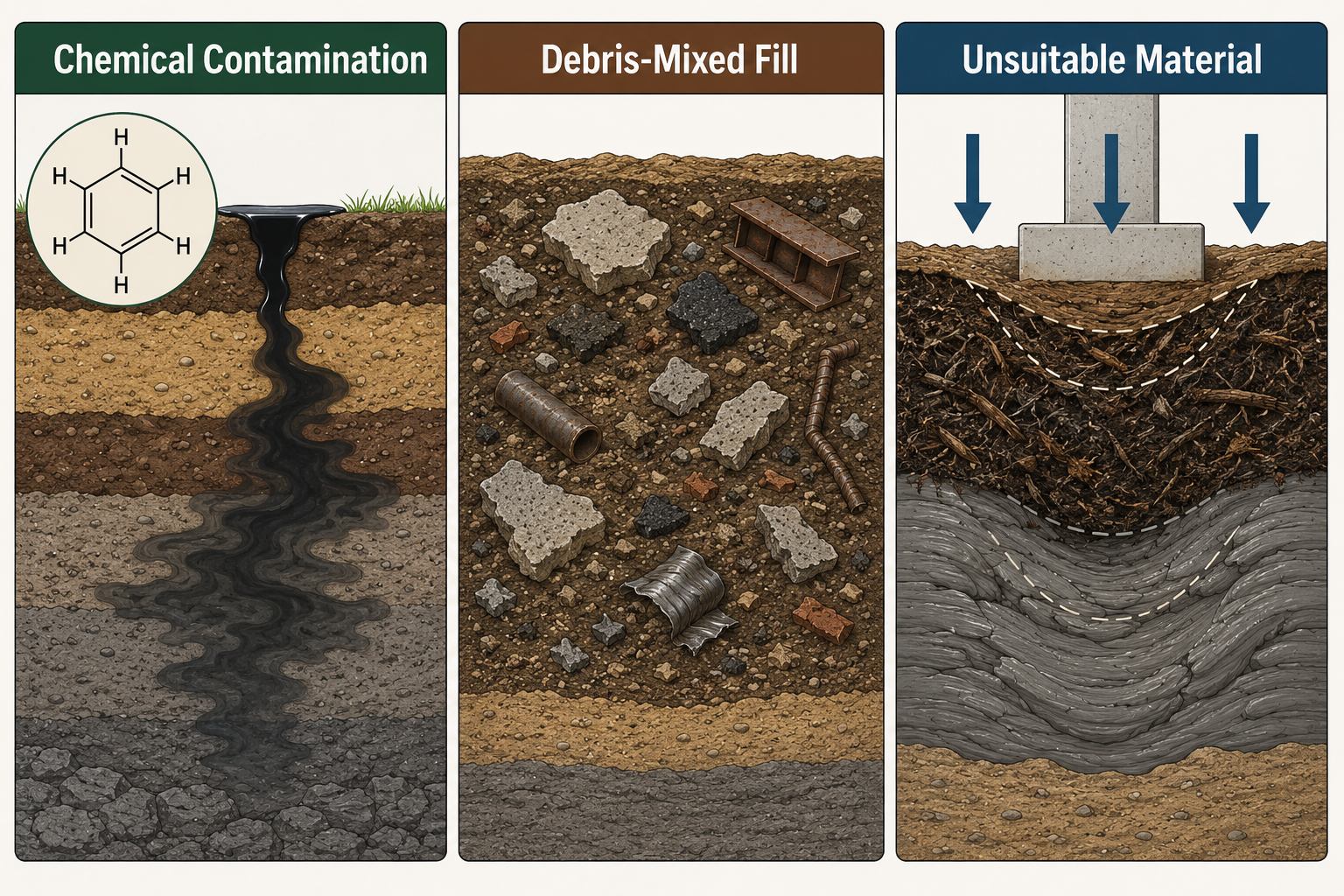
Muck. High-organic-content clay. Saturated fill that will not pass compaction. Florida has more of this than most states, sitting under developed parcels throughout the region. It does not have to be contaminated to be a problem. It just has to be wrong for the job.
All three types fall under what the trades call dirty dirt. None of it can go where clean fill goes. Each type has its own handling path. Getting them confused costs money and creates exposure.
Why Florida Has More of It
Tampa Bay carries decades of industrial history in its soil. Gas stations, dry cleaners, manufacturing operations, chemical facilities. They occupied parcels that are now prime development targets. When those businesses closed, the contamination did not leave with them.
Underground storage tanks are a specific and widespread source. More than 30% of Florida’s underground storage tanks have leaked, leaving petroleum-contaminated plumes that can extend far beyond the original tank location. Those plumes are still being excavated on active job sites across the region today.
Agriculture adds another layer. Citrus operations covered large portions of this state through most of the 20th century and relied on arsenic-based pesticides. That arsenic is still in the soil on former grove sites, including parcels in Hillsborough and surrounding counties now being converted to residential and commercial development.
The land looks cleared. The contamination is not gone.
Old dry cleaners are a third common source. Perchloroethylene, the solvent used in dry cleaning operations, migrates downward through the soil profile. Former strip mall parcels throughout Tampa Bay carry this contamination at depth, often undetected until excavation begins.
This is not an edge case in this market. In a fast-growing region built on layers of prior use, dirty dirt is the norm, not the exception.
What Florida Law Requires
The legal framework starts with Florida DEP Chapter 62-777 F.A.C., Table II Soil Cleanup Target Levels. These are the numeric thresholds, measured in milligrams per kilogram, that define whether soil is legally clean or legally contaminated in Florida. If a soil sample comes back above those numbers for any listed compound, the material cannot be reused or disposed of as clean fill.
A sample of the thresholds contractors encounter most often on Tampa Bay sites:
| Contaminant | Residential (mg/kg) | Industrial (mg/kg) | Common Source |
|---|---|---|---|
| Arsenic | 2.1 | 12 | Former citrus operations |
| Lead | 400 | 1,400 | Old industrial sites, paint |
| Benzene | 1.2 | 1.7 | Petroleum leaks, USTs |
| PCBs | 0.5 | 2.6 | Electrical equipment, old industrial |
| Mercury | 3 | 17 | Manufacturing, fluorescent lighting |
| Chromium (hex) | 210 | 470 | Metal finishing, tanneries |
For active excavation work, Florida DEP Standard Operating Procedure 19 governs how contaminated soil must be identified, segregated, manifested, and disposed of. It is the operational rulebook for any contractor touching suspect material on a Florida job site.
One specific trigger matters in the field. An organic vapor analyzer reading above 10 parts per million requires mandatory segregation under SOP 19. That number is not a guideline. When the OVA hits 10 ppm, the excavation stops for clean fill, the material is separated, and chain of custody begins. Ignoring it is a compliance failure, not a judgment call.
How Site Serve Handles Contaminated Soil from Site to Finish
Site Serve’s process on contaminated soil jobs follows the same sequence every time. Each step has a purpose. Cutting any of them creates problems downstream.
Assessment Before Anything Moves
Before a bucket touches a suspect parcel, the crew identifies what is in the ground. OVA screening, visual inspection, soil texture and color evaluation. The goal is to know what is there before it gets disturbed and mixed into material that was clean.
On sites with known or suspected contamination, Florida regulations require a Phase I Environmental Site Assessment before excavation begins, and often a Phase II assessment with actual soil sampling. These are conducted by licensed environmental consultants, not the excavation contractor. Site Serve coordinates directly with those consultants and follows the site assessment findings to the letter. The cleanup target levels set by Florida DEP Chapter 62-777 are not open to interpretation on the job site. They are the standard, and Site Serve holds to them.
Most problems start because someone skipped this step.
Isolation
Dirty material is separated from clean fill the moment it is identified. Stockpile locations are established and maintained separately. Clean material stays clean. Contaminated material goes to its own staging area.
Cross-contamination on a job site is expensive to remediate and easy to prevent at the front end. The discipline here saves everyone involved.
Excavation and Loading
Contaminated soil is excavated separately and loaded into covered haul trucks. Chain of custody documentation starts at this point. The material is tracked from the moment it leaves the ground.
Transport to a Certified Facility
Every load goes to a Florida-licensed disposal facility equipped to handle the specific contamination type. Manifests travel with the trucks. This is not discretionary.
A contractor who hauls contaminated soil to a clean fill site has created a liability for the landowner receiving it, not just for themselves. Florida law does not distinguish between intentional and uninformed violations.
Documentation
When the job is done, Site Serve delivers full disposal documentation. The general contractor and developer have a complete paper trail: what was removed, where it went, what facility accepted it. DEP compliance requires this. Lenders and title companies are increasingly requiring it before closing on developed parcels.
The paper trail is not a formality. It is proof that the problem was handled correctly and cannot come back.
Where Site Serve Has Done This Work
The dirty dirt problem shows up across every project type in Tampa Bay. Site Serve has handled contaminated soil disposal on demolition sites, former gas station parcels, subdivisions, and industrial pads. From large-scale marina developments like Westshore Marina District to institutional projects like First Baptist Church to commercial expansions across the region, the soil conditions change but the process does not.
The contractors who rely on Site Serve for this work include Balfour Beatty, BTI Partners, and CSI Construction. These are firms that do not tolerate process failures. That standard runs through every contaminated soil job Site Serve takes on.
Site Serve operates across the full Tampa Bay region: Tampa, St. Petersburg, Clearwater, Wesley Chapel, Brandon, Riverview, and surrounding areas. Fully licensed and insured.
Why It Matters Who Handles Your Dirty Dirt
The knowledge to identify, isolate, manifest, and dispose of dirty dirt correctly is not standard across the industry. A lot of contractors know how to move dirt. Fewer know how to move the wrong dirt the right way.
That is the work Site Serve has built its reputation on. Not the visible part of a project. The part that determines whether everything built on top of it holds.
Getting dirty dirt wrong costs more than getting it right.
Site Serve gets it right.
